Virtual Datacenter (VDC Flex)

Warning !
work in progress : content under review, subject to change
Overview
A Virtual Data Center (VDC) is a pool of cloud resources—such as CPU, memory, storage, and networking—that is allocated to a specific tenant within the cloud environment.
It acts like a virtual version of a physical data center, allowing tenants to create and manage their own virtual machines and resources independently.
IaaS Dual Site, virtual data centers (VDC) based on Flex allocation model. Flex allocation model supports all allocation configurations & control the CPU and RAM consumption at both the VDC and the individual virtual machine (VM) levels.
Computing capacity (CPU + RAM) and storage are available according to several classes of services.
Tenant Segmentation
By default no interconnection between tenants, they are completely isolated with other tenants.
This mechanisms ensure that workloads, networks, storage belonging to one tenant remain logically and operationally isolated from other tenants
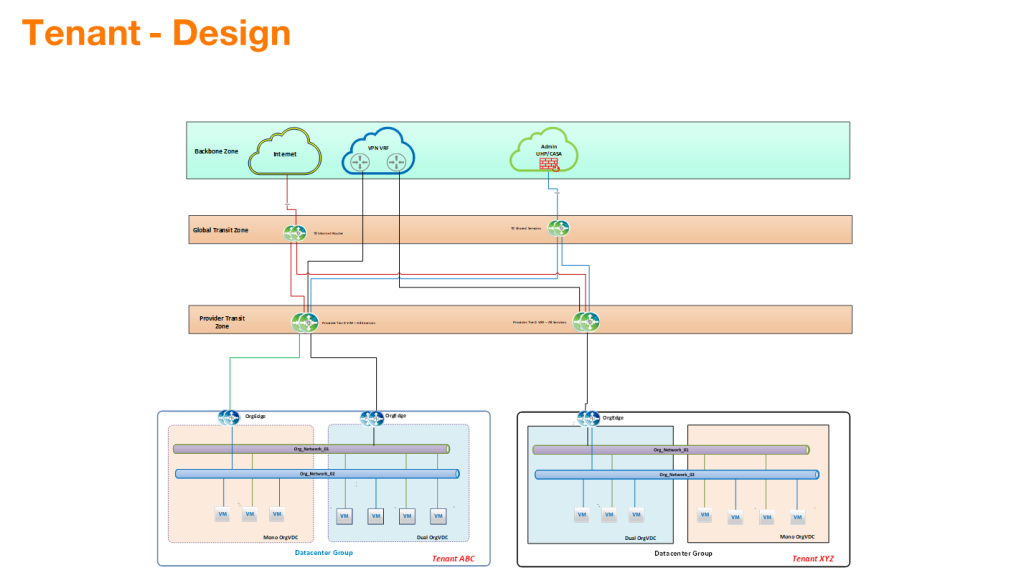
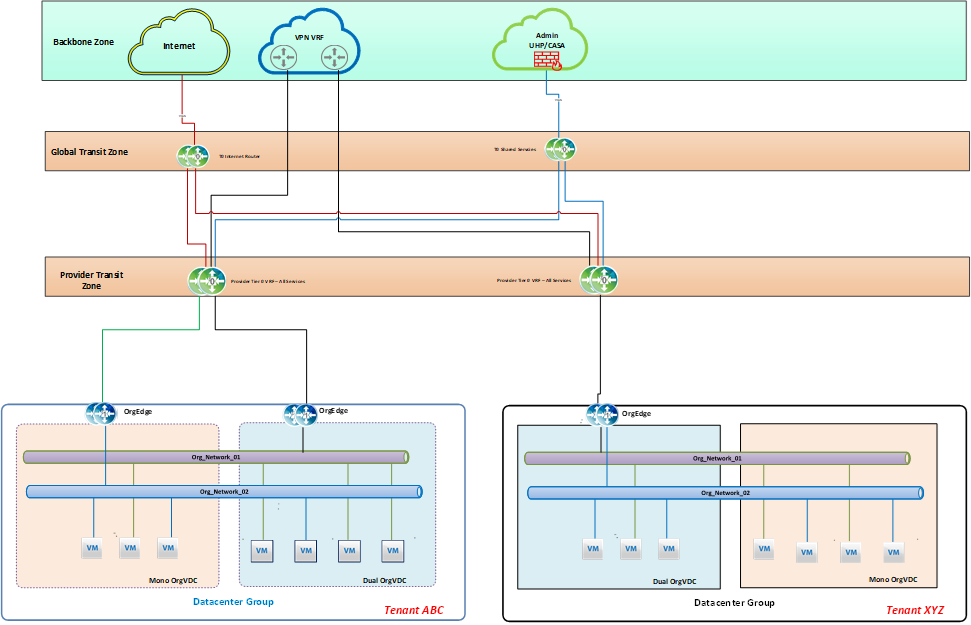
The IaaS Dual Site service zone is a dedicated service area within Cloud Avenue. It is isolated from the Standard IaaS service zone and operates with its own control plane, compute infrastructure, and storage infrastructure.
Within this service zone, a tenant (also referred to as a vOrg in VMware terminology) can contain one or more Virtual Data Centers (VDCs). VDCs belonging to the same tenant can communicate with each other when required.
By default, there is no connectivity between tenants. Tenants are fully isolated from each other at the network, compute, and storage levels. This mechanism ensures that workloads, networks, and storage resources belonging to one tenant remain logically and operationally isolated from other tenants.
Although isolated from the Standard IaaS service zone, the IaaS Dual Site service zone remains integrated with Cloud Avenue shared services, including:
- Backup services
- External network connectivity services
- Shared storage services
- Platform services such as KaaS and DBaaS
Service Scope and Limitations
The IaaS Dual Site service zone is designed as an independent environment and does not support all Standard IaaS use cases.
The following use cases are not supported:
- Disaster Recovery (DR/PRA) between the Standard IaaS service zone and the IaaS Dual Site service zone
- Dedicated clusters within the IaaS Dual Site service zone
Customers requiring these capabilities should refer to the Standard IaaS service offerings.
Availability Classes
The IaaS Dual Site service zone is deployed across two geographically separated datacenters located approximately 100 km apart: Val de Reuil (VDR) and Chartres (CHA).
Leveraging Broadcom vSAN Stretch Cluster technology, the platform provides two availability classes that can be assigned at the virtual machine level:
- Dual Site Availability: Virtual machines are protected across both sites, providing service continuity in the event of a site failure.
- Single Site Availability: Virtual machines are deployed within a single site and are intended for workloads that do not require cross-site resilience.
Availability classes can be mixed within the same Virtual Data Center (VDC). This allows customers to align resiliency requirements with workload criticality.
For example, a customer can deploy production workloads using Dual Site Availability while hosting development, test, or pre-production workloads using Single Site Availability within the same VDC.
vDC Specifications and Performance Classes
This section describes the available Performance Classes, VM sizing options, and the compute resource model used within Flex vDCs.
Performance Classes
The IaaS Dual Site service provides three Performance Classes designed to address different workload requirements:
- Eco
- Standard
- High Performance
Each Performance Class offers different compute characteristics and service levels. Customers can deploy virtual machines using predefined templates or custom configurations based on their workload requirements.
VM Sizing
Virtual machines can be deployed using either predefined VM templates or custom configurations.
Predefined templates provide standard T-shirt sizes for common workload profiles, while custom configurations allow customers to define their own vCPU and memory allocation.
Tenants are requested to review their workload requirements carefully before initiating deployments and ensure compliance with the approved sizing matrix.
|
Service class |
Eco V VM FlavoursMVM |
Standard VM Flavours |
High Performance VM Flavours |
|
| VM limits (vCPU / RAM / Storage) |
1. E1 1_1 1VCPU/1G RAM 2. E1 1_2 1VCPU/2G RAM 3. E1 2_2 2VCPU/2G RAM 4. E1 2_4 2VCPU/4G RAM |
1. S1 1_4 1VCPU/4G RAM 2. S1 2_4 2VCPU/4G RAM 3. S1 2_8 2VCPU/8G RAM 4. S1 4_8 4VCPU/8G RAM 5. S1 4_16 4VCPU/16G RAM 6. S1 8_16 8VCPU/16G RAM 7. S1 8_32 8VCPU/32G RAM 8. S1 8_64 8VCPU/64G RAM
|
1. H1 4_8 4VCPU/8G RAM 2. H1 8_16 8VCPU/16G RAM 3. H1 16_32 16VCPU/32G RAM 4. H1 4_16 4VCPU/16G RAM 5. H1 8_32 8VCPU/32G RAM 6. H1 16_64 16VCPU/64G RAM |
|
| Allocation mode |
Flex |
Flex | Flex | |
| Mono Room | ▲ | ▲ | ▲ | |
| Dual Site | ▲ | ▲ | ▲ | |
| Billing mode | PAYG | PAYG | PAYG | |
| vCPU Share | 2000 | 4000 | 6000 | |
| vCPU Frequency | 2 GHz | 2.5 GHz | Unlimited | |
Compute Resource Model
Flex vDC Allocation Model
Flex vDC is designed to provide granular control over compute resource allocation while maintaining flexibility and infrastructure efficiency.
The platform uses a hybrid resource allocation model where CPU and memory resources are partially guaranteed and partially elastic. This approach balances workload performance, resource utilization, and operational flexibility.
The model is designed to provide predictable performance while maximizing overall platform efficiency.
vDC Resource Management
Resource allocation within a vDC is defined by the customer during service provisioning and can be adjusted as requirements evolve.
The allocated vCPU and memory capacity represent the maximum amount of compute resources available to workloads running within the vDC.
A virtual machine can be powered on only when sufficient resources are available within the vDC allocation.
The following conditions must be satisfied:
- Total allocated vCPUs of running virtual machines plus the vCPUs requested by the virtual machine being powered on must remain within the vDC vCPU allocation.
- Total allocated memory of running virtual machines plus the memory requested by the virtual machine being powered on must remain within the vDC memory allocation
Performance Class Implementation
Performance Classes are implemented through a combination of CPU resource scheduling policies and processor performance characteristics.
vCPU Shares
During periods of resource contention, CPU scheduling priority is influenced by the selected Performance Class.
CPU response time represents the time between a workload becoming ready to run and the moment CPU resources are assigned by the hypervisor.
Expected behavior during resource contention:
- High Performance: Very low likelihood of performance impact
- Standard: Low likelihood of performance impact
- Eco: Moderate likelihood of performance variation
vCPU Frequency
Each Performance Class is associated with processor frequency characteristics aligned with different workload profiles.
Typical workload guidance:
- Eco (2 GHz): Suitable for non CPU-intensive workloads
- Standard (2.5 GHz): Designed for general-purpose enterprise workloads
- High Performance (2.5–3.5 GHz): Optimized for CPU-intensive workloads that benefit from higher clock frequencies and turbo capabilities
These characteristics help customers select the most appropriate Performance Class according to their application requirements and performance objectives.
Availability and Resiliency
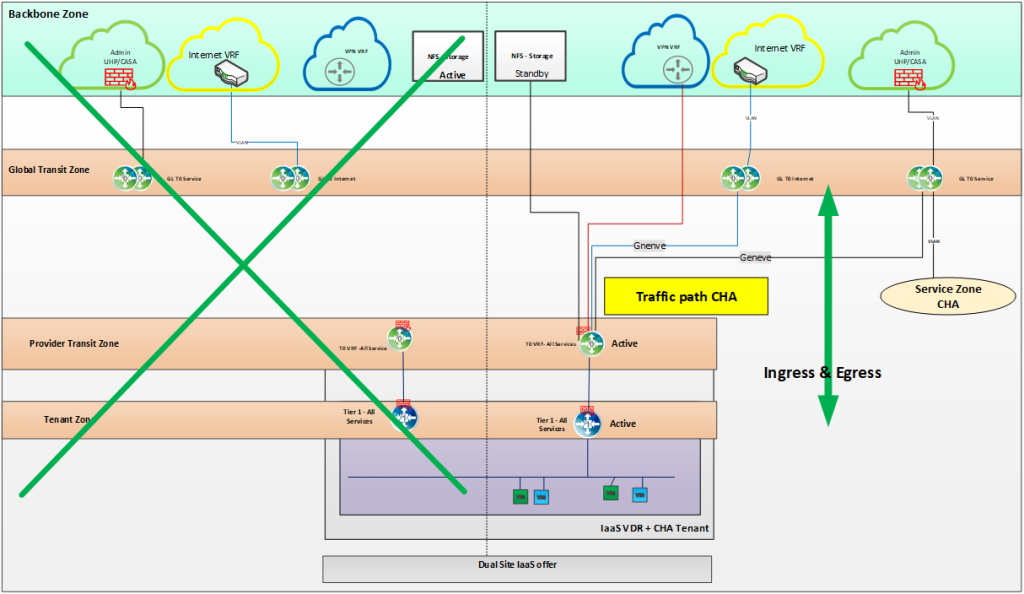
The IaaS Dual Site service is deployed across two geographically separated datacenters: Val de Reuil (VDR) and Chartres (CHA).
The platform is built on a stretched infrastructure architecture leveraging Broadcom vSAN Stretch Cluster technology. Compute, storage and network services are distributed across both sites to provide infrastructure-level resiliency.
Workload Distribution Model
For workloads deployed using the Dual Site Availability Class, virtual machines can run on compute resources located on either site.
This distributed architecture provides:
- Reduced dependency on a single datacenter
- Improved infrastructure utilization across both sites
- Increased service continuity in the event of a site failure
- Operational flexibility for workload placement
The platform operates in an active-active infrastructure model across both sites.
Important: Infrastructure-level active-active operation does not imply application-level active-active operation. Application resiliency, clustering and load-balancing architectures remain the responsibility of the customer.
Customers may deploy application components across both sites when their application architecture supports such designs.
Site Failure Behavior
The behavior of workloads during a site failure depends on the selected Availability Class.
Dual Site Availability
Dual Site virtual machines benefit from infrastructure resiliency provided by the stretched cluster architecture.
In the event of a complete site failure, workloads continue operating from the surviving site without requiring a dedicated Disaster Recovery platform or manual recovery procedures.
Service continuity is built into the infrastructure design.
Single Site Availability
Single Site virtual machines are hosted on resources located within a single datacenter.
These workloads remain protected against local infrastructure failures within the site through standard VMware High Availability mechanisms.
However, protection against a complete datacenter failure is not provided. In such scenarios, workloads hosted in the affected site become unavailable until the site is restored.
Disaster Recovery
The IaaS Dual Site service integrates native site resiliency through its stretched architecture.
For workloads deployed using the Dual Site Availability Class, site-level recovery capabilities are built into the platform and do not require a separate Disaster Recovery environment.
Customers requiring application-level Disaster Recovery processes, cross-region recovery strategies, or business continuity procedures should design these capabilities according to their own application requirements.
Billing model
Virtual machines can be deployed using predefined instance templates or custom configurations with a customer-defined number of vCPUs and memory.
Compute charges are based on the following attributes:
- Performance Class (Eco, Standard, or High Performance)
- Availability Class (Single Site or Dual Site)
- Allocated vCPU and memory resources
Virtual machines are billed on an hourly basis according to actual usage.
To simplify cost management, monthly charges for a continuously running virtual machine are capped at 650 billable hours per month.
Pay-As-You-Go Pricing
The service uses a Pay-As-You-Go (PAYG) pricing model, allowing customers to provision and consume resources on demand without upfront commitments.
Resource Commitments
Customers can benefit from discounted pricing through resource commitments with 1-year or 3-year terms.
Unlike reserved instances, commitments are applied to a pool of vCPU and memory resources associated with a specific Performance Class and Availability Class. Committed resources can be consumed by multiple virtual machines within the eligible service scope.
This approach combines the flexibility of PAYG consumption with the cost benefits of long-term resource commitments